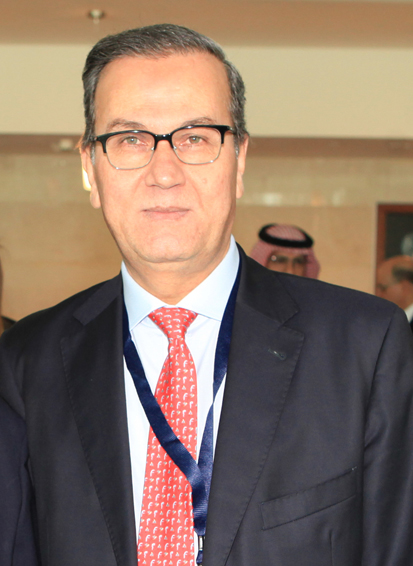

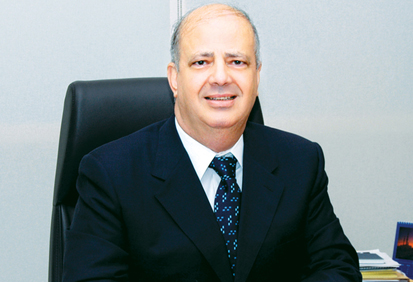
In this interview with Mr. Joe Hatem, the general manager of the Profiles Software company, we had the chance to learn about the secrets behind 34 years of success and growth in the Software business. We also discussed issues such as the spread of Covid-19 and its effects on the current general economic situation in the country and the IT sector in specific.
* You are celebrating your 34-years anniversary of developing and implementing the business solutions in your company.
– How would you describe the start, locations, and current situation of your work?
We just celebrated 34 years of operation of our company, Profiles Software.
This is an occasion to reminisce on the journey: three friends deciding, back in 1986, to start a company providing three types of services: software, graphic arts, management support. Rapidly, software became the main activity, and then became the only one. Also rapidly, based on demand from the market, we specialized in business software, with a single platform covering a large span of the corporate business needs. The platform was named PIMS, for Profiles Integrated Management System, and today, the market knows the acronym PIMS better than it knows Profiles.
The word ERP did not exist at the time, yet PIMS is definitely an ERP. Right from the start, the concept was quite standard-based, with one solution for all clients, at a time when most software solutions were being tailor-built based on individual client requirements. The lengthy implementation process was being replaced by a rich set of options, in the same way that the same Word or Excel serve the whole community, each user configuring it to their personal needs.
Over the years, the team expanded from 3 persons to 25. The office moved 4 times, sometimes evading the heavily bombed areas during the war, often times to a larger space and closer to the capital Beirut. The development platform also changed radically 3 times, and the set of features gets richer by the day.
The number of clients serviced grew steadily, as well as their geographical locations, and the variety of their fields of activity. We covered service companies, then traders, distributors, industries, retail, academic, health and governmental institutions. Our first clients were in Beirut then, over the years, we covered most of our diaspora market, Gulf, Africa, and some.
– What about your future plans?
Looking back, Profiles Software is among the Lebanese software companies that survived the challenge of time. We have carved our share of the market, while being careful at every stage to preserve the reputation through high quality standards, personalized support, and solid internal structures. We will continue on this successful path, expanding the features offered, and enlarging our market perimeter.
*The crisis caused by the spread of Coronavirus has prompted a large number of companies to allow their employees to work from home, which has positively affected companies working in the programming field.
– How has this transformation reflected on your sector?
Presently, all our team operates from the comfort of their homes. Using connectivity technology, remote access and formal communication, we maintain an uninterrupted level of operation and customer support. It is fortunate that, in this field, serving clients does not require absolute physical presence. We were already well equipped to serve clients in distant places that we never visited; now we are also equipped to operate without seeing each other but on a screen.
– Is there any increase in your profits after the pandemic?
We serve the business community. With the confinement, many businesses had to suspend their operation, and this reduced their need for our services. For other businesses, software has become increasingly necessary to maintain their operation. As the teams of our clients are also now working from their homes, we had to assist them to relocate or restructure the deployment of their systems accordingly.
In days like these, profitability is not the major concern, the challenge is sustainability. With a large number of clients, we sustain a mild impact from the harsh times endured by the market.
* The software industry is one of the most important fields of work at the present time.
– Are there any efforts to develop this sector to higher levels than what it is at the present?
On the level of the software community at large, and over the past period, the effort by the various software providers to improve the quality level of their performance has been consistent. Through increased specialization, software providers are focusing more on complementarity, rather than competition.
Our challenge today is to finally materialize this often repeated dream, that Lebanon could – and must – become the “Silicon Valley of the Middle East”. Our governmental institutions are expected to realize that, eventually, this is the industry where Lebanon can excel and secure the much needed income from outside the country. We have seen timid results lately, with a Ministry of Technology at a point in time.
Without waiting for results from the governmental instances, the software players on the market are also regrouping into joint initiatives to promote their penetration of markets abroad: exhibitions, promotion, lobbying.
– How do you deal with the Corona virus crisis, in terms of the technical services and the maintenance?
How we operate through the confinement of Corona / COVID?
When clients call our phone numbers, they get answered. Our team members answer from their homes; clients often do not realize that we are not in our office for the moment. Using the various remote connection techniques, we serve our clients with the same efficiency as if we were in office. Often, the callers are themselves team-members of their companies, operating from their homes.
We have quickly adapted to this new way of operation, and I believe that our clients had to accept being serviced through remote support. One wonders whether, once the confinement is over, working using remote technology would not remain the main trend.
– What is the impact of the dollar exchange rate on your business?
It is obvious that the extreme drop in the exchange rate of the national currency, as well as the blocked banking deposits and the difficulty to deal with foreign currencies, all this has had a very sharp impact on the business at large. Inasmuch as the business of our clients is affected, it is to be expected that our business be also affected.
We are all, clients and providers alike, currently focusing on the challenge of keeping our businesses ongoing, sustainable, even though not always profitable. History has taught us that, in Lebanon, we are bound to go through difficult periods every now and then. But we, the Lebanese, have proved our resilience, our ability to adapt and to find the opportunity in every new situation.
– Did you raise your costs?
We have maintained our nominal tariffs unchanged. On the other hand, what keeps changing is the rate of collection and, with it, the purchasing power of money. In a sense, Lebanon has become a competitive provider on many fronts, as a result of the currency drop. We need to consider this competitive edge as an asset, an opportunity of which we must take advantage.
– Do you have any plans, in 2021, to create new innovative solutions and technological products to develop the work experience at the time of the digital transformation?
Thanks to a very systematic internal organization, our development team has been able to continue operation without being noticeably affected by the confinement. As a result, our permanent path of improving our existing modules and of developing new features has not stopped, on the contrary.
With the obvious necessity to address an ever expanding market share, covering new business sectors and new geographical territories, these challenges are boosting the dynamism of our developments on many fronts: new human interface languages to meet new cultural environments, retail delivery, loyalty schemes, data security, remote accessibility, more powerful integration with other applications, etc.
– Can the Lebanese IT companies benefit from the current situation? And increase their spread? And their expansion in foreign markets?
The Lebanese software community has many assets that add value to what we can offer on other markets: our youth enjoys a quality education; they grow in an environment very connected with other cultures, and are familiar with their habits and traditions; they master two, three, sometimes four languages. All this makes it possible to export, in a variety of exporting models. For a long while, our youth expatriating and sending remittances to their families has been a booming export, unfortunately. But new models are now emerging, such as:
– Individual outsourcing, whereby one gets employed in a foreign company while working from Lebanon.
– Corporate outsourcing, whereby a foreign company – sometimes owned by Lebanese – sets up a development and/or support center in Lebanon, serving their foreign markets.
– subcontracting, whereby a development team based in Lebanon develops applications for foreign companies, on a project basis.
– Export of solutions, whereby software publishers based in Lebanon sell their software solutions or services through agents in foreign countries. This is the case of Profiles Software.
International markets are ever more competitive and specific, new technologies keep emerging, these are challenges that our community must meet, through permanent adaptation and continuous learning.
More than ever, Lebanon must work on re-balancing our exports to cover our imports. Imports can only shrink to a vital minimum, and must at least be covered by our increased exports.
We are confident that though our current competitive situation and our incentives to lookout, software should eventually become a significant source of national income, similar to what silk production was for Lebanon about a century ago.