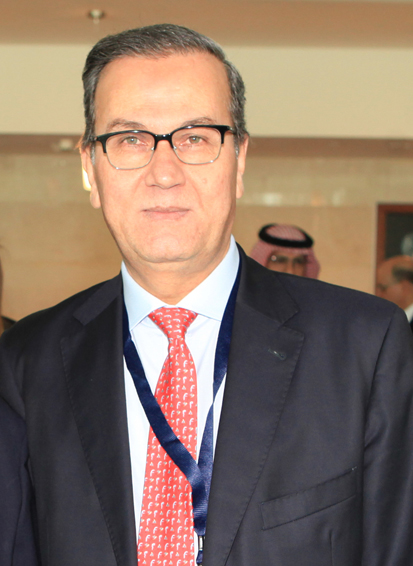


Mr. Andreas Pollmann, Client Management Executive at Munich Reinsurance Company’s Divisional Unit in the Middle East and North Africa (MENA), talked about the regional insurance market, and highlighted the main events of last year. He also discussed the effects of the new IFRS 17 standard, the technology and the economic situation in some countries, on the development of this sector. And he confirmed at the end of this interview that the past year was for sure very successful for the Munich Re Group.
* The new accounting standard, IFRS 17, is facing the insurance sector globally and regionally…
– Are there any specific drawbacks and observations about this new standard?
– As a company, where are you from applying it?
From what we can expect at this stage, IFRS 17, in my opinion, will completely change the current rules for external IFRS disclosure and will therefore also change the related steering, forecasting and planning approaches of insurance companies globally. Internally, we have set up a Group-wide program to address the multiple challenges accompanying the new standard with its primary objective to enable the Munich Re Group to fully comply with IFRS 17 requirements in 2022.
In my view it is making sense if all stakeholders in the industry, from insurance companies, to brokers, regulators and service providers alike, start immediately applying their minds on the currently foreseeable changes to their accounting, capital management and financial key performance indicators. The process of conversion to the new accounting regime is holistic, complex and with deep impact – so the best advice is to start and to anticipate the changes for the business reality early now. At the moment, the standards are still in discussion on a number of aspects and the effects are different for long tail and short tail classes of business, so it is even more important in my opinion to the assume know how leadership on this important topic.
* Technology has strongly invaded the insurance world, as well as other service and production sectors.
– What are the new transformations that the technology brought into this sector?
Rapidly evolving technologies are disrupting and revolutionizing a wide array of industries, including insurance. Generally speaking: Digitalization greatly enhances the possibilities of providing customers with useful, convenient and affordable services on an ongoing basis. The increased frequency of interaction increases the emotional bond to the insurer, especially when losses occur.
The most crucial technological challenges our industry is facing are around data management, improved risk understanding, diversified customer service, connectivity and company efficiency. Aspects like disruptive technologies, new competitors, user centricity, artificial intelligence and connected world are main areas of transformation for the entire insurance industry. I sense that insurance companies in the MENA region have either the choice to become part of the transformation and shape it for their market and customers or to become irrelevant over time as changing customer ownership and administration cost advantages will render some companies uncompetitive.
* Do you think that the difficult economic conditions coupled with several financial, technological and technical challenges… may lead to mergers between insurance companies in the region? And the withdrawal of some of the markets?
The transformation of the insurance industry and the developing requirements and demands, both emanating from technological and customer end, make massive investments into IT, manpower and know how necessary. In addition, the increased level of supervision makes corporate governance, data protection, compliance and reporting another field of investment into processes, people, competences and systems. This basket of instrumental requirements demands massive investments which can only be brought by strong insurance companies with an attractive franchise and an even more attractive business model.
In my opinion, the faster the technological transformation progresses and finds its way into the insurance industry, the faster the pressure on consolidation grows. If you add regulatory and economic developments it becomes merely a mathematical equation until when the consolidation will start to gain momentum in MENA markets.
* While reinsurance companies are talking about the return of price increases and the tightening in the conditions… the regional markets are witnessing fierce competition that leads often to a decline in prices…
– What’s your opinion in this regards?
Generally speaking, I see a lot of reasons for upward adjustments of prices, terms and conditions, and nothing to the contrary. Many risks are still underpriced i.e. the reinsurance premium is often not commensurate with the underlying exposure. A clear trend that supports my view is the development in the facultative reinsurance market where it becomes more and more difficult to place risks at expiry terms or even at higher prices as there is simply not enough capacity available from some sources that were previously available at terms that were made available in the past.
However, one has to look at the market situation in a differentiated way. There are areas of attractive business that markets search for and budgets that need to be filled. If one adds the fact that there is still sufficient treaty capacity by providers with less market or underwriting intelligence it is easy to notice that the market can still be assessed as being fiercely competitive. But, this in my view is only one side of the coin as the fundamental basics of less reinsurance capacity are obvious reading the news of the last months. The other side of the coin is that the retro market, which is used by many reinsurance companies, also recently offered firm terms only late, which I interpret as a sign of lower appetite. In addition, the historically low yield curves have to be considered as the “new normal”, so investment income cannot compensate for insufficient prices anymore, especially in long-term business.
In the aggregate, the prove is still in the selection of the right business and the right partners complemented by the quality of capacity and value adding service in the long-term.
* What are your company’s achievements in 2019 at all levels?
We will publish our results for the full year of 2019 on 28 February, 2020. The year 2019 will have been a very successful year for the Munich Re Group according to the published figures and the outlook at this stage, assuming that nothing unexpected happens in the capital markets or with claims at the end of 2019.
Our ambition is to continue to make the best values of Munich Re available for our clients in the region and to take global trends, group-wide developments, investments and innovations and adapt them for the local and regional needs of our clients and consumers. We, the MENA team at Munich Re feel as achievers if and when we join into successes with our clients and partners mutually.