


A number of heavyweight Lloyd’s (re)insurers have posted worsening ٢٠١٨ results because of a deteriorating claims experience from Japan’s Typhoon Jebi and the US’ Hurricane Michael but in contrast the market’s ٢٠١٧ result continues to improve, analysis of the latest syndicate forecast returns by The Insurer has shown.
Syndicates operated by Brit, XL Catlin and Hiscox all showed worsening figures in the latest forecast returns-echoing a trend seen among listed reinsurers in the recent half-year reporting season.
Syndicates with third-party investors publish updated quarterly forecasts for three years until the syndicate closes.
Typhoon Jel – which struck Japan almost a year ago
– has seen toss estimates mushroom from an initial $٢- ٣bn to estimates of around $١٦bn. One of the drivers of the creep has been attributed to the severe winds that struck a large area of high-value construction ahead of this year›s Rugby World Cup and next year›s Olympic Games.
While Florida›s controversial assignment of benefits law -which, until recent reforms, allowed aggressive lawyers to take over claims recoveries – has contributed to Hurricane Michael’s insured loss estimate doubling from an initial $٦bn to a current $١٢bn.
Brit›s Syndicate ٢٩٨٨ says its mid-case forecast loss on the ٢٠١٨ underwriting year is now ١٩.٧٤ percent of capacity, a deterioration of ٧.٣١ percent on its previous forecast. Although the company has not given a reason for the deterioration, The Insurer understands that Jebi and Michael were both factors.
Hiscox›s SPS Syndicate ٦١٠٤ endured similar deterioration on its mid-case forecast, with its forecast ٢٠١٨ result declining ١٠ percent from ٥٥ percent of capacity to ٦٥ percent.
In contrast, it›s much larger flagship Syndicate ٣٣ maintained its ٢٠١٨ forecast result at a predicted ٥.٠١ percent loss of capacity.
Both ٦١٠٤ and ٢٩٨٨ are syndicates that underwrite alongside their parents› larger syndicates with the former providing exclusive property cat reinsurance capacity to ٣٣. In contrast to Hiscox, Brit does not publish quarterly forecasts for its main Lloyd›s Syndicate ٢٩٨٧ as in contrast to ٢٩٨٨ it does not have outside investors.
XL Catlin›s Syndicate ٦١١١ also endured deterioration at the second quarter. The forecast id-case loss of capacity declined ١٢.٨١ percent from a positive predicted result of ٧.١٤ percent to a loss of ٥.٦٧ percent of capacity.
Separately, the Verto Syndicate ٢٦٨٩ – which wrote a substantial whole account quota share of XL›s business in ٢٠١٨-also endured deterioration with Jebi understood to be a major contributor. The syndicate›s ٢٠١٨ forecast mid-case result declined ٨ percent to a ١٢ percent loss this week. Earlier this year, Verto was effectively subsumed into Beat Capital›s Syndicate ٤٢٤٢.
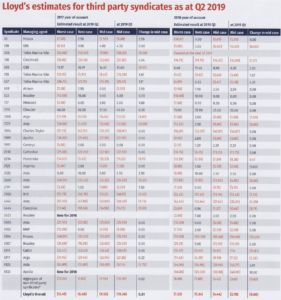
Overall, Lloyd›s aggregate ٢٠١٨ forecast result deteriorated modestly-٠.٦٦ percent-to a loss of ٤.٤ percent, analysis of the forecasts show (see table).
In contrast, a number of Lloyd›s syndicates experienced positive development on the ٢٠١٧ year – the worst ever year for insured cat losses – which at an aggregate level saw Lloyd›s mid-case forecast improve by ٠.٨١ percent of capacity to a loss of ٩.٥٥ percent (previous quarter a loss of ١٠.٣٦ percent of capacity).
Syndicates publishing quarterly forecasts with notable improvements include Chaucer ١١٧٦ with an improvement of ٦.٥ percent to ٥١.٥ percent. The syndicate specialises in nuclear business and is traditionally the most profitable Lloyd›s syndicate. The former Munich Re-owned Syndicate ٣١٨-now owned by US specialty carrier Cincinnati – also published an improved mid-range forecast of ٤.٥٤ percent of capacity, albeit still to a substantial forecast loss of ٣٢.٦٦ percent.
In contrast, notable declines on the ٢٠١٧ year were Brit›s Syndicate ٢٩٨٨ once again, declining ٣.٠٣ percent mid-case to ٥١.٢١ percent, and Asta – managed Syndicate ٦١٢٣ which fell ٣.٧٥ percent to ٦٠.٨٩ percent.
Lloyd›s insiders expect the broad trend of syndicates with third-party capital to post improving results for the ٢٠١٧ year to continue later this year before they close at year-end. This is because, typically, managing agents with non-aligned investors release reserves from prior years towards the end of the three-year cycle.