


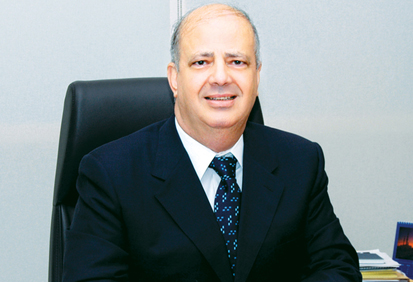
Mr. Andreas Pollmann, Client Management Executive at Munich Re, talked about the insurance market and the lessons learnt from the Covid-19 pandemic.
He also highlighted the importance of the Middle East market for Munich Re and discussed the company’s latest investments and achievements.
* As the effects of Covid-19 pandemic began to recede…
What are the consequences of this pandemic on the insurance sector?
Various markets experience economic movements caused by the pandemic of manifold nature and impact. While trade, tourism and exports have seen decrease, other sectors like digital economy and consumer behavior experienced rapid developments. This lead to, as we believe temporary, pressure on top line movements in premium income – in some cases to a noticeable extend for insurers. On the consumers’ side, end users have shifted to digital purchases in many industries, putting convenience in focus. The searching and buying behavior of insurance products in particular moved significantly to the online world. Insurers needed to adapt quickly and offer digital sales, in order to be close to their clients. Further, with the uptake of online sales and transactions, there is an increased demand for cyber insurance and coverage. We expect that economies regain their strength also but not limited to the increased global economic activity and the recent increase in oil demand and price. The changed consumer behavior, which is into digital convenience and service is here to stay in my opinion.
* What about the lessons learnt from it?
Key lessons are in my view with impact on capital and balance sheets, competition and insurance market texture.
First, capital of some insurers is more exposed than many thought, resulting from less premium income, relatively higher cost and fluctuations in the valuation on the asset side. Competition increased and fights commenced in all cases where insurers compete only on price and not on value and service of their policies and products. The consequences of these stressful circumstances will be become visible soon in some insurers’ P&L. Third, going forward the insurance industry benefits from adapting quickly to changed consumer demand and needs to increase service and decrease cost at the same time. The answer lies in digitalizing processes, a stronger analytical driven price segmentation and effective sales and claims administration tools.
* The pandemic imposed new patterns of work, the most important of which is the remote work.
How do you assess this experience? Do you think that the companies will continue to operate according to these patterns after the end of the pandemic?
New routines have been developed and now there will be a time coming to refresh personal relationships and create new ones through genuine face time – so I expect a hike in travel, soon, in the international B2B area. However, mid-term, some of the new digital communication routines will complement and enrich continuous dialogue with our clients. I expect that in principle digital meetings, trainings and even conferences will stay as one element of interaction as it proved to be practical, effective and by now – an accepted mode of communication. For all digital interaction one fundamental element applies which is the necessity to protect remote work, intellectual property and communication from a recently fast increasing cyber threat.
* The importance of technology has emerged greatly during the last period…
What about your company’s investments in this field?
We managed to quickly adjust to the new digital and remote working environment that suddenly was forced onto the world in beginning 2020. On a general scale, investment into IT infrastructure, cloud computing and cyber protection have been and still remain top priorities for us and every business entity.
* What about the pricing and the conditions of the renewals?
Clients seek stability, continuity and top capacity from us. This is accompanied by additional value adding services that support clients with new products and instruments for sales and servicing of policyholders – this includes digital solutions where we note an increased demand!
* What importance do you give to the Middle East and North Africa region in your work? Are there specific plans for it?
The MENA region is considered an important and relevant part of our divisional business at Munich Re. The estimated economic growth, the ongoing dynamic development and the activities in transformation to higher sophistication in many important markets in MENA are a fantastic development opportunity. We are pleased to contribute to this by shaping and supporting developments in many ways.
* What steps did you take with regards to paying the compensations for the Beirut Port explosion on August 4?
The event that happened on 4 August 2020 is a human and an economic tragedy and affects a large part of the Lebanese population for a long time. We contribute as much as we can to deliver on the promise that reinsurance and insurance gives, by providing capacity and security to our strong and professional clients. And also by contributing to move things to the better as good as it is reasonably possible.
* What about your good company’s results for the first quarter of this year?
Munich Re is on track for the 2021 target and generated a profit of €589m in Q1 2021. The operating result increased year on year to €798m (397m), particularly owing to a considerably lower burden arising from COVID-19 losses – especially in property-casualty reinsurance. Gross premiums written increased by 1.9% year on year to €14,551m (14,284m). Equity was slightly lower at the Q 1 reporting date (€29,392m) than at the start of the year (€29,994m). The solvency ratio was approx. 217%, which is at the upper end of the optimum range (175–220%). In Q1 2021, return on equity (RoE) amounted to 10.4%. Munich Re expects gross premiums to increase to €57bn in 2021. Reference is made to the press and analyst reports published and to Munich Re internet website, where more detail can be found.